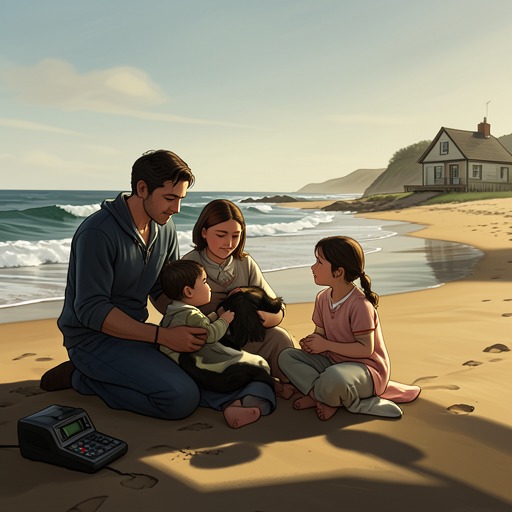
Villa Blustergull
The Summer BookVilla Blustergull is the house a businessman builds on Blustergull Rock, less than a mile from Sophia and Grandmother’s home. Its significance is larger than its size: it interrupts a horizon that had seemed familiarly and securely arranged, and makes the family’s far-flung position in the archipelago no longer unique. The house first stands for an unwelcome alteration of island life; after Sophia and Grandmother visit it, it also becomes a complicated point of curiosity and an enduring marker of change.
A House on the Horizon
The construction is initially met with silence. Over the years, people have acquired the habit of leaving painful matters unspoken in the hope that silence will make them less painful. But not speaking about the new house does not make it disappear. Island residents habitually let their eyes travel over the horizon, taking reassurance from the familiar outlines of skerries and from channel markers remaining in their accustomed places. Villa Blustergull breaks that visual order: the big, square house makes the view feel interrupted and the horizon less their own.
The disturbance is also a change in who inhabits the outer reaches. The anonymous skerries that had formed the family’s threshold to the sea have acquired a name, while the new neighbor’s house means that Sophia and Grandmother’s family is no longer the one living farthest out. Less than a mile separates them from the newcomer, close enough for his presumed habits to become part of their unease. They imagine that he may welcome company, bring a large family, disturb the moss, play the radio, and talk a great deal. These are fears about what the house could bring, not a record of what its owner actually does; the anticipation makes the new building a social presence before anyone has met its occupant.
The roof completes the construction’s first appearance. Workmen nail on a huge, glittering tin roof beneath the cries of gulls and terns, then leave by boat. The house is finished, but its owner does not arrive for several days. During that interval, the building remains an unanswered presence on the horizon: its inhabitants are unknown, while its effect on the view is already plain.
Grounds, Boundaries, and Design
Near the end of the week, Sophia and Grandmother row out in the dory. They pass the perch shallows, continue to Squire Skerry to look for seaweed, and reach Blustergull Rock by way of the lagoon. The landing has no dock, only a broad gravel bank. There, a large sign announces that the property is private and trespassing is forbidden. Grandmother decides they will go ashore. In her account of the etiquette, an empty island ordinarily should not be entered when its owner is absent; putting up a prohibition, however, turns the matter into an insult that calls for a demonstration. Sophia accepts the reasoning, and they tie their boat to the sign.
The visit lets them see how thoroughly the house has altered their impression of the place. The vegetation has not been cleared: the owner has built broad catwalks above the heather and blueberry bushes and left the grey junipers standing. He has taken care not to damage the plants, yet the island seems lower, flatter, and more ordinary to the visitors. The contrast matters. The offense, for Grandmother and Sophia, is not simply careless construction; even a house that preserves its vegetation can make the landscape feel wrong because, in their view, the island should not have had a house at all. From nearby, the building appears fairly low, though Grandmother allows that it might have been attractive elsewhere.
On the terrace, the house identifies itself with a fancily carved plaque bearing the name Villa Blustergull. Its decorative maritime fittings—a pair of new ship’s lanterns above the door, a grappling iron, a freshly painted red buoy, and artistically arranged glass floats—give the place an elaborate, newly assembled character. Grandmother also objects to practical choices: the door is on the wrong side to open in a southwester, and the water barrels are plastic. Her expectation that the owner will learn how to live in the place distinguishes the island’s accumulated local knowledge from the house’s conspicuous display of nautical style.
The Owner Arrives
After sitting on the terrace with their backs to the house, Sophia and Grandmother look across the long island; from that angle it seems wild and lonely again. Sophia’s attention turns to the possible consequences of an inexperienced neighbor. She expects that he may not know how to sink rubbish properly, so cans and bottles could wash ashore and catch in the family’s nets, and she complains that everything he owns is too big. The concern links the house to the sea’s movement: what is discarded at one shore may become another household’s problem.
The owner’s arrival changes the visit from a demonstration against an empty property into a tense encounter. They hear a motor approach, grow quiet, and Grandmother tells Sophia to look without being seen. Sophia returns pale with the news that the owner is there. Grandmother, suddenly terrified, urges her to keep hidden while watching what he does. From beneath the aspens, Sophia sees a large mahogany boat with an antenna on its cabin, a dog, and a skinny boy in white; the boy and dog jump ashore together.
The owner, Malander, eventually calls to them from under the scrubby trees and introduces himself and his son, whom the family calls Tofer. Grandmother crawls out, introduces Sophia, and attempts to recover her dignity while picking pine needles from her hair. Their first meeting has already exposed the mismatch between the firm boundary announced by the sign and the human awkwardness of confronting the people on either side of it. When Malander reacts with distress to the padlock and says he had admired the mainland skerry folk, Grandmother quickly recasts their curiosity as an understandable response to a closed-up place. She suggests that leaving a key on a nail would be better. The explanation is improvised and leaves Sophia blushing, but it reveals how their ideas of island custom differ from the property owner’s expectations.
They go into the house for refreshment, framing the visit as neighborly socializing. Tofer welcomes them; shutters are opened one after another, and the large room fills with sunlight. Malander describes the picture window and invites them to sit while he gets drinks. Sophia looks around furtively and clings to the back of her chair, while Grandmother tells her that she must learn how to socialize. The house, previously a visual intrusion and then the object of a trespass, becomes the setting for an awkward attempt at hospitality.
From Intrusion to Landmark
As Sophia and Grandmother row away, their start is jumpy and amateurish: the oars have been stowed backward and become tangled in the painter. Malander follows along the shore to the point and waves a handkerchief as they leave. Sophia’s bemused response prompts Grandmother to interpret him as someone who wants to be left alone but has not yet recognized it. She predicts that he will build a dock anyway, while insisting that every person has to make his own mistakes. The visit has made her sad: Malander has an idea he is trying to work out, she thinks, but understanding may come too late for him to begin again, or the idea may be forgotten before he recognizes that he has lost it.
On the way home, Grandmother looks back at the house interrupting the horizon. It begins to resemble a channel marker—not because the change has been reversed, but because the building can now serve as an objective indication that change has occurred. This shift in perception does not make Villa Blustergull welcome. It makes the house legible as a landmark through which the family can read an altered landscape.
Malander never returns their visit, and Villa Blustergull remains fascinating to consider. Whenever a storm comes, Sophia and Grandmother think about him and try to work out ways to save his boat. Their attention has moved beyond the first anger at the house’s presence to concern about the neighbor and his vulnerability to the same sea that shapes their own lives. The building thus persists in two roles at once: an interruption of the family’s sense of an untouched horizon, and a fixed point from which they watch the consequences of living farther out.